

Religious Education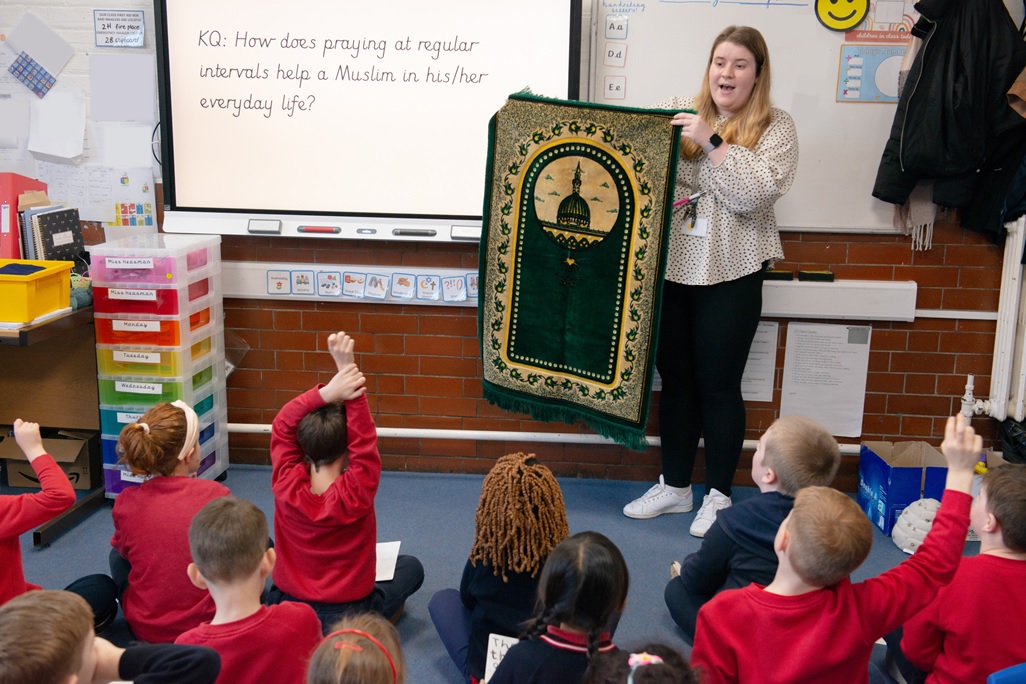
Our RE curriculum is designed, using Living Difference and Understanding Christianity, to give children an appreciation and understanding of core Christian concepts, other major religions of the world and non-religious worldviews. Where possible, our RE curriculum makes links between religions studied and Global Neighbours through cross curricular links.
Intent: What we expect children to learn
Through RE we aim to enable pupils to know about and understand Christianity as a living world faith, by exploring core theological concepts and to develop knowledge and skills in making sense of biblical texts and understanding their impact in the lives of Christians. We also aim to develop a knowledge and meaningful understanding of other world faiths particularly those represented in the UK and how religious beliefs shape our lives and our behaviour, develop the ability to make reasoned and informed judgements about religious and moral issues and enhance our spiritual, moral, social and cultural development. We also look at a non--religious worldview in year 5 & 6, which is Humanism.
As a Church of England school, Religious Education plays an important role, along with all other curriculum areas, particularly PSHE and the teaching of British Values, in promoting the spiritual, moral, social, and cultural development of our children.
Implementation: How we teach the subject
At Moordown St John’s Church of England Primary School, our curriculum for Religious Education (RE) finds inspiration from a number of sources, especially the ‘Living Difference IV’ Hampshire-agreed syllabus and Understanding Christianity units.
Across the key stages, children are taught about a range of religious and non-religious cultures and traditions:
EYFS/KS1
- aspects of what it means to live life in the Christian traditions
- a depth study of aspects of what it means to live in a second tradition (Jewish traditions) an overview of other traditions (Abrahamic (Christian traditions, Muslim traditions, Jewish traditions) and Dharmic (Hindu traditions, Buddhist traditions, Sikh faith traditions))
KS2
- further aspects of what it means to live life in the Christian traditions
- a depth study of two additional religious traditions; one across Year 3 and 4 (Hindu traditions), and another across Year 5 and 6 (Muslim traditions)
- an overview of other traditions and perspectives (Abrahamic, Dharmic and non-religious (humanist approach to life))
In line with the Living Difference IV syllabus, units are taught as a ‘cycle of enquiry’.
- Communicate
- Apply
- Inquire
- Contextualise
- Evaluate
Understanding Christianity
‘Understanding Christianity’ is a resource used to support the teaching of units focused on Christianity. The Understanding Christianity approach comprises three elements which run through all units: making sense of the text, understanding the impact, and making connections.
msj re subject guide 2026 27.pdf
Impact: How we evaluate the knowledge and skills they have learned
Through an engaging and exciting RE curriculum, all children will make progress and develop their skills and knowledge. At the end of each unit teachers assess their learning through an assessment task. By the end of their primary education, pupils will be able to use the following skills:
- Investigation – this includes: asking relevant questions; knowing how to use a variety of sources in order to gather information.
- Interpretation – this includes: the ability to draw meaning from artefacts, works of art, poetry and symbolism; the ability to interpret religious language.
- Reflection – this includes: the ability to reflect on feelings, experience, attitudes, beliefs, values, relationships, practices and ultimate questions.
- Empathy – this includes: the ability to consider the thoughts, feelings, experiences, attitudes, beliefs and values of others
Children are assessed in a variety of ways allowing them to demonstrate their knowledge and overcome barriers to learning, such as difficulties with reading and writing.
Whole School RE overview
msj re curriculum overview.pdf