

Phonics
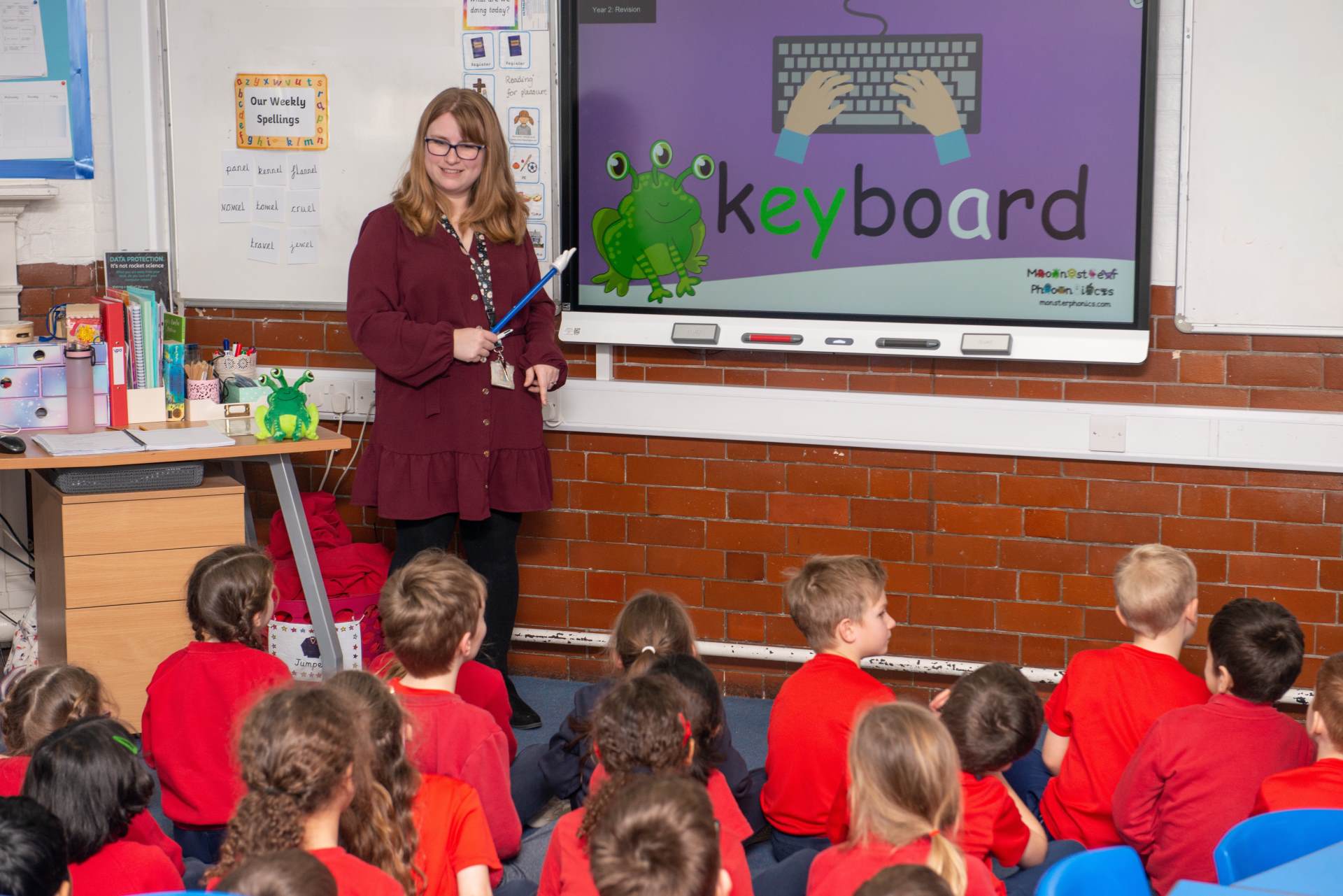
Our Phonics Scheme: Essential Letters and Sounds
Please see the links below for guidance on the pronunciation of the pure sounds:
Phase 2: https://www.youtube.com/watch?v=nBFnAcXHOUQ
Phase 3: https://www.youtube.com/watch?v=gDInVjBUGC0
Phase 5: https://www.youtube.com/watch?v=8BwWD2ZlvBY
Phonics forms an essential part of our school curriculum, giving children the important skills needed to successfully begin their journey as readers and writers. The ability to read is one of the most important of all life skills and phonics is the key building block at the very start of a child’s reading journey. Phonics teaching is critical in enabling children to decode for reading. It is also important in enabling children to encode for spelling in their writing. This is why phonics forms such as important part of our curriculum within early years and key stage one at Moordown St. John’s. Our phonics curriculum builds progressively on prior learning, using repetition and interleaving to help children to commit their learning to long term memory.
Intent: What we expect children to learn
At Moordown St John’s, we aim to provide a secure foundation in both the ability to read (decode and blend) texts and to use phonics to spell (segment and encode) phonetically regular words. Children will be confident in using learnt strategies to read and spell common exception words that do not follow our spelling patterns. These will be known to the children as harder to read and spell words. The use of Essential Letters and Sounds (ELS) will provide a structured and sequenced approach to phonics learning, alongside a predictable and consistent lesson structure which allows children to focus on the phonics content of the lesson. Through this, all children will have a secure basis to flourish into confident readers and writers.
Implementation: How we teach the subject
Teachers will use our phonics scheme (ELS) to teach a rigorous, sequenced and structured phonics curriculum where children build their cumulative phonics knowledge. Teachers will deliver high-quality first teaching of well-structured lessons, that include in the lesson intervention to ensure all children make progress. There will be consistency in the approach of all staff, using ELS actions, terminology and key teaching elements. Children will be taught daily teaching on phonics in Early Years and year one, which is built upon by ELS Spelling in year 2. This will be complemented by the use of accurately matched phonics levelled texts for the children to apply their learning within guided reading.
Children will be taught phonemes and graphemes sequentially to build their cumulative phonics knowledge. This begins in Early Years with oral blending, phase 2 grapheme-phoneme correspondences, phase 3 grapheme-phoneme correspondences and phase 4 word structures.The children will be exposed to the content of the phase 5 common sounds in the second half of the summer term in EYFS, which will then be retaught in Autumn 1 of year one. In year one, the children build on this learning to include alternative and lesser-known grapheme phoneme correspondences within phase 5. In the second half of the summer term, the children in year 1 will be exposed to some of the spelling patterns of year 2, such as words with silent letter. In year two, phonics will take a spelling approach focusing on spelling patterns, suffixes and words with silent letters.
Previous learning will be constantly reviewed within lessons and through the use of review lessons. Assessment points will be used to inform the review section of the lesson structure and the content of review lessons where appropriate.
Phonics intervention will be used to support pupils to close gaps in their learning. This is in addition to the in the lesson intervention, which is an in the moment response to those children needing additional support. For children who need it, phonics support and teaching will continue into key stage two in small groups or through focused IEP targets.
Impact: How we evaluate the knowledge and skills they have learned
Children moving from key stage one to key stage two will have a secure basis to build their reading and writing skills. This will enable them to progress in their learning and flourish as readers and writers.
By the end of key stage one pupils will be able to:
- Recognise and identify graphemes from phase 2 to phase 5 within words, including alternative and lesser-known phoneme grapheme correspondences.
- Decode and blend graphemes for reading, including within polysyllabic words.
- Recognise and read common exception words (known as harder to read and spell words) by sight.
- Recognise and read high frequency words by sight.
- Use segmenting and encoding to spell phonetically regular words.
- Spell common exception words (known as harder to read and spell words) for key stage one.
Children will be assessed in a variety of ways including. This will include using assessment for learning within lessons of grapheme recognition, word reading, application of knowledge in apply booklets, application of knowledge in a decodable reading text and spelling at word/sentence level. Teachers will use formative assessment to identify pupils needing additional support and quickly use in the lesson intervention to address gaps in learning. There are also regular assessment points built within the progression of the scheme to assess grapheme recognition, recognition of most recent graphemes taught within words and recognition of high frequency words using phonics tracker. These are typically within week 5 of a half term, so that teachers can use this data to inform their teaching in a meaningful way.
Progression Map:
|
|
EYFS |
|
Autumn |
s, a, t, p, i, n, m, d, g, o, c, k, ck, e, u, r, ss, h, b, f, ff, l, ll, j, v, w, x, y, z, zz, qu, ch, sh, th (voiced & unvoiced), ng, nk, ai, ee, igh, oa |
|
Spring |
oo (short), ar, ur, oo(long), or, ow, oi, ear, air, ure, er, ow (oa), review and consolidation of prior learning |
|
Summer |
Phase 4 word structures: CVCC, CCVC, CCVCC, CCCVC, CCCVCC Exposure to phase 5 common graphemes: ay, ou, ie, ea, oy, ir, ue, aw, wh, ph, ew, oe, au, ey, a_e, e_e, i_e, o_e, u_e, c (s) |
|
|
Year One |
|
Autumn |
ay, ou, ie, ea, oy, ir, ue, aw, wh, ph, ew, oe, au, ey, a_e, e_e, i_e, o_e, u_e, c (s), y (ee), al (or) review and consolidation of prior knowledge |
|
Spring |
a (ai), ey (ai), ea (ai), eigh, a (ar), e (ee), i (igh), y (igh), o (oa), a (o), u (oo), u (yoo), ch (c), ch (sh), ea (e), or (ur), ear (ur), ou (oo), oul (oal), ie (ee), ve (v), y (i), are (air), ere (air), ear (air), tch (ch), o (u), g (j), ge (j), dge (j), st (s), sc (s), se (s), gn (n), kn (n), wr (r), mb (m), se (z), ze (z), eer (ear), ere (ear), ti (sh), tion, al (ar), augh (or), ss (sh), si (zh), tious, ci (sh), ous, ion, ian |
|
Summer |
Review and consolidation of prior learning sc (s), ne (n), gh (g), gu (g), ou (u), gh (f), ou (o), oo (u), o (oo), wh (h), u (w), ei (ee), i (ee), ough (oa), our (ur), re (ur), te (t), ar (or), oar (or), oor (or) |
|
|
Year Two (ELS essential spelling) |
|
Autumn |
spellings of ai, spellings of ee, spellings of igh, spellings of oa, spellings of oo, g (j), ge (j), dge (j), kn (n), gn (n), wr (r), ey, c (s), il (l), oor (or), i (igh), o (u), a (o), al (or), a (or), s (zh), si (zh), homophones, or (ur), ar (or), o (oo), wh (h), ea (ai) |
|
Spring |
el (l), le (l), al (l), doubling the consonant when adding suffix -ed, -er, -y, -est and -ing, homophones, o (oa), e (ee), o (oa), apostrophes for contraction, apostrophes for possession, drop the /e/ when adding the suffix -ing, -ed, -er, -y and -est, ar (a), -tion endings, oul (oo), spellings of common exception words |
|
Summer |
suffix -ment, suffix -ly, suffix -ful, suffix -less, suffix -ness, y (ee), y (igh), drop the /y/ and add /i/ when adding -ed, -es, -er and -est, spellings of common exception words |